
Postal Customs Data
Identify what data and documentation is required when sending on our globalpriority Europe and globalpriority ROW services.

A customs declaration is required for all parcels exported from the UK to overseas destinations, as well as for parcels imported into the UK. As the sender, you’re responsible for ensuring the declaration is full and accurate, as you are legally liable for the parcel’s contents.
Customs authorities rely on this information to check that items meet national regulations and to determine any taxes or duties that may apply. If the declaration is incomplete or inaccurate, your parcel may be delayed, held, or returned by customs, resulting in longer delivery times.
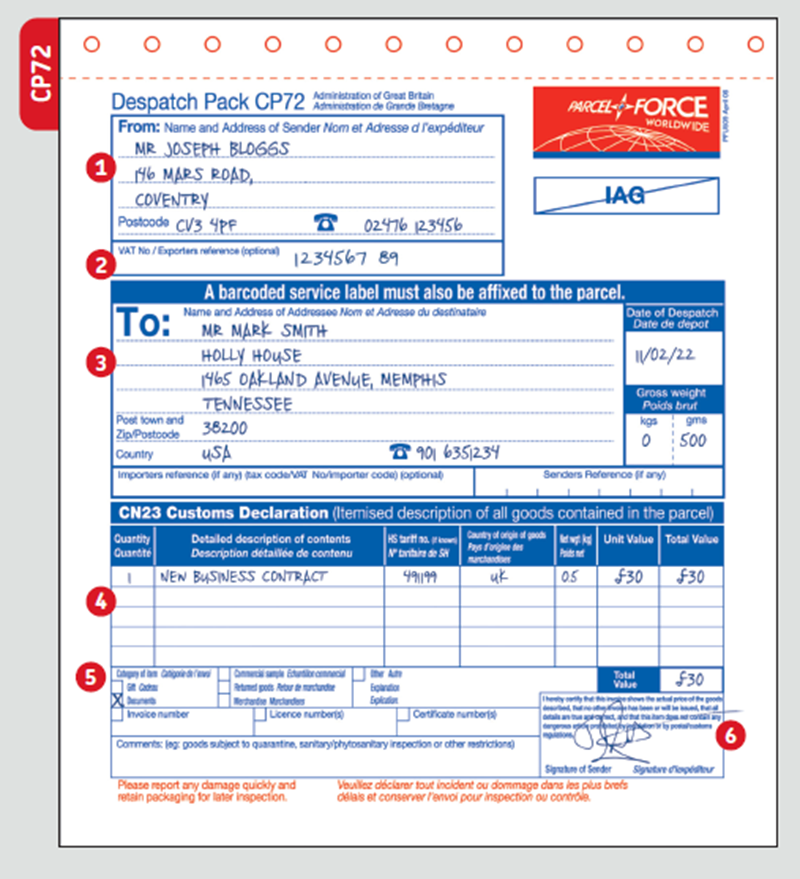
The CN23 and CP72 are the standard postal customs declarations used internationally to capture essential details about the contents of a parcel to support postal customs clearance processes in both the UK and overseas destinations.
Each destination is responsible for setting their own import controls on restricted goods. Customers are advised to identify whether items being imported into a specific destination will require licences / certificates or incur additional charges. To identify specific country requirements, please visit our individual country pages.
*Please note: When sending items from Northern Ireland to the EU, no customs declarations are required for sending gifts or goods. Our shipping platforms may still ask for the data and produce a CN23, however you should not attach it to the parcel.
Where required, supporting documents such as certificates and licences must be physically supplied when sending your item. These documents should be placed in a clear plastic wallet securely affixed to the outside of the parcel, ensuring all information is fully legible.
We recommend attaching the wallet on the same side as the address label wherever possible. If space is limited, it may be placed on the reverse of the parcel, provided it remains clearly visible and securely affixed.
Missing, invalid, or incomplete documentation can result in your item being delayed, held by customs, or returned to the sender. All supporting documents must be completed accurately before collection or drop off at a Post Office® or depot.
As the sender, you are responsible for ensuring that all information provided for customs purposes is true, complete, and accurate. Parcelforce Worldwide cannot be held liable for incorrect or misleading declarations. We strongly advise familiarising yourself with the relevant export and import customs regulations before shipping.
*Please note: If purchasing our services via the Post Office® you will only be asked to complete a CP72.
Electronic customs data is mandatory for all international parcels. The easiest way to do this is via our online journey.
Any parcel with missing, incorrect, or incomplete electronic data may be delayed, held by customs, or returned to the sender.

This is the documentation you should expect to see and be asked to complete if sending your item at the Post Office®.
| Products | Data Needed | Documents |
|---|---|---|
|
globalpriority Europe |
Sender’s details in FULL, including contact details Ensure the sender’s full name, address, and a valid postcode are included. We also recommend providing contact details, such as a mobile phone number and/or email address. This helps ensure you can be reached if customs or delivery partners need further information about the item. A GB EORI number or VAT registered number (if applicable) if the sender is a business. Recipient’s details in FULL, including contact details. Overseas customs authorities require accurate recipient contact information. Providing local recipient contact details, such as a mobile number or email address helps ensure the recipient can be reached promptly if additional information is needed. Failure to include this information increases the risk of customs delays, which may impact delivery times. Reason for shipment (category/nature of goods) For example, sales of goods, returned goods, commercial samples. Note the ‘gift’ category can only be used for C2C mailing (i.e. goods exchanged between private individuals). Content description This must be a concise and accurate description without unnecessary detail (e.g. children’s t-shirt / board game / chocolate bar). For more clarity, please refer to the links below: WCO guidance on acceptable descriptions Please note: ambiguous or generic descriptions are not allowed. Customs use the content description to facilitate border checks and apply the correct duty rates. The HS/tariff code (minimum 6 digits) HS (Harmonised System) codes or tariff codes are an internationally recognised standard used to identify goods consistently across global customs systems. Because these codes are universally adopted, customs authorities worldwide can understand the type of goods being shipped, regardless of language barriers. This helps streamline customs processing and reduce delays. While the first six digits of an HS code are standardised globally, any digits beyond this are national extensions. Customers must ensure they verify the correct tariff code for the destination country, as requirements can vary. For more information on finding the correct HS/tariff code, please click here. Please note: Parcelforce Worldwide cannot be held liable for the HS code selected. Value of each individual item in the parcel Please do not combine the value of the parcel if the contents are not the same. When sending a parcel containing a mixture of goods, each item must be listed separately. Every product requires its own line entry with complete and accurate details. Identical items may be grouped on a single line, but you must include the total quantity and the total value of those items combined. The item value refers to the customs value of the goods only and must not include postage or shipping costs. Items cannot be declared as having zero value, regardless of the reason for sending them. This rule applies to gifts, samples, returns, repairs, and all other item types. For guidance on how to correctly value goods for customs purposes, please click here. Weight per individual item in the parcel Accurate weights are required for each line item in the parcel to ensure that the customs duty and taxes can be calculated where applicable to weight-based calculations. Country of origin This means the country where the goods originated e.g. were produced, manufactured, or assembled. Postage Postage should be declared separately and not included in the item value calculation. Sender’s signature This confirms your liability for the item in terms of the contents of the parcel. |
CP72 /CN23 Documentation required will vary dependent upon method of purchase. |
Certain goods exported to specific countries may require an export licence or additional documentation often issued by relevant regulatory bodies. Where a licence or certificate is required, it must be physically attached to the outside of the parcel in a clearly marked envelope.
Customers must also provide details of these documents electronically during the booking process.
Before shipping, please check with the appropriate government department to confirm whether your goods require any additional licences or certificates. The following resource may be helpful when determining export requirements:
For parcels sent to destinations outside of the UK, the thresholds at which taxes and duties become payable vary by country and are determined by the local customs authorities. We strongly recommend checking the threshold applicable to the destination you are sending to.
Customers should also refer to the destination country’s official customs authority website to ensure they have the most accurate and up to date information on thresholds, import restrictions, and any additional requirements.
For customers sending items from Northern Ireland to the EU, a customs declaration is not required. As NI remains aligned with the EU Customs Union, customs taxes and duties do not apply. Where duties are applicable for other international destinations, they are typically calculated based on the contents, value, and weight of the parcel.
Yes, if you are shipping item(s) to the Channel Islands you will require customs declarations. This includes Jersey, Guernsey, Alderney, Herm, and Sark. Please note goods to Jersey may also be liable for GST (Goods and Services Tax) which is currently 5%. Find out more about shipping to the Channel Islands at our Worldwide Directory.
There are a range of organisations in the UK who can help you with all the above. As a starting point and for additional information about exporting goods from the UK please visit the HM Revenue & Customs website here.
To check your item is not prohibited or restricted, please click here.
For UPU or country-specific prohibitions and restrictions, please click here.

Still have questions?
Get in touch to discuss customs commercial data or call your account manager if you are an existing account customer.